
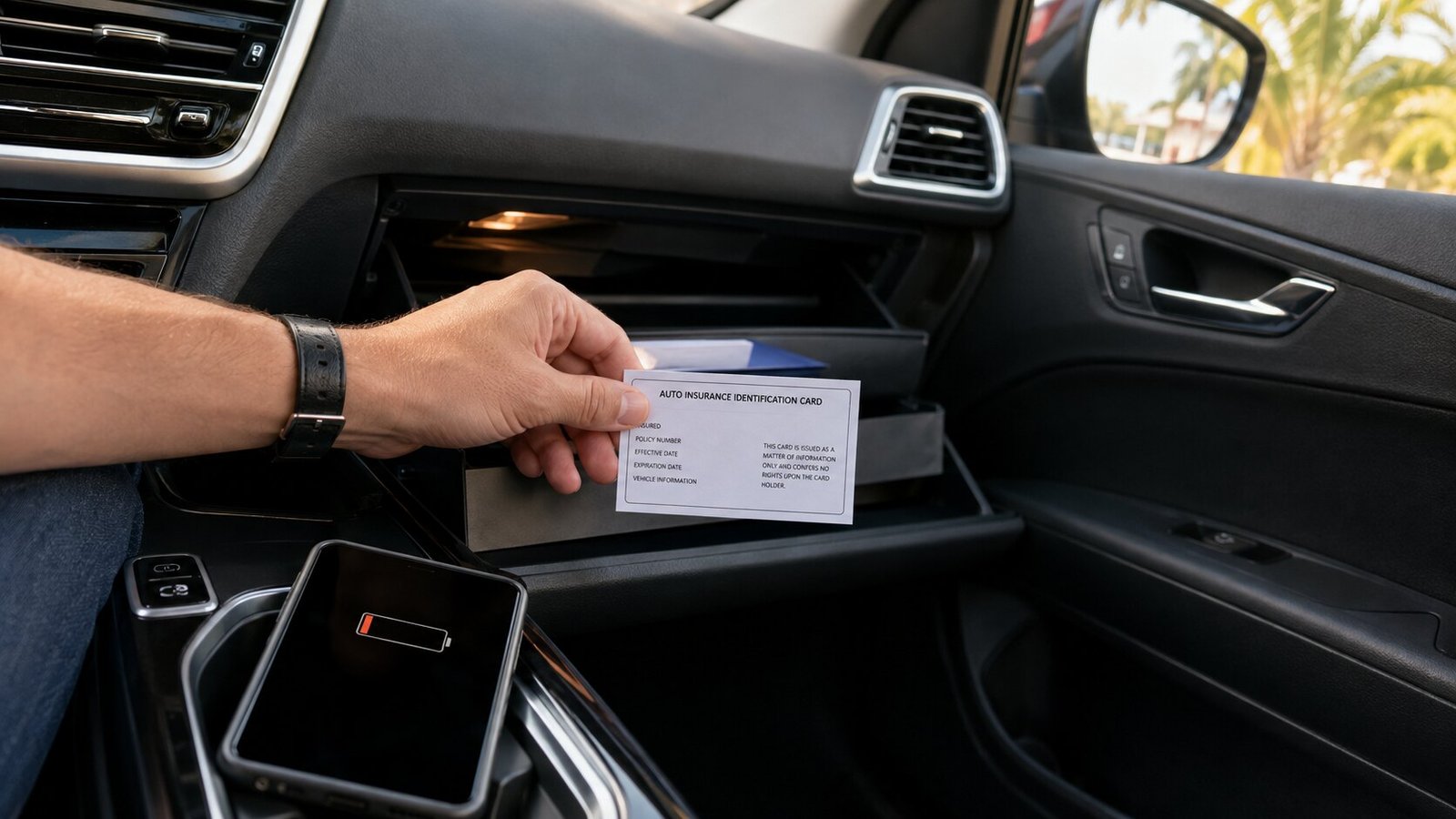
Quick answer: Digital insurance ID cards are genuinely useful, and I keep one on my phone like everyone else. But after decades of helping Florida drivers, I still tell people to keep a current paper card in the glove compartment too. It’s not about distrusting the technology. It’s about the moments when technology is the last thing you want to be fighting with.
I want to be upfront about something before I get into this: I’m not the guy who thinks paper is better than an app. I have the digital card. I use it. It’s fast, it updates on its own, and ninety-nine times out of a hundred it does exactly what it’s supposed to do.
This isn’t that article.
This is about the hundredth time.
Where the Digital Card Works Just Fine
Most of the moments you’ll ever need proof of insurance are calm, ordinary moments. Someone at your apartment complex wants to see it. A new employer needs it on file. You’re getting a parking permit, or registering a vehicle, or a storage facility wants it before they hand you a gate code. Renting a car works the same way — the counter agent wants to see proof before you drive off, and pulling it up on your phone is quick and painless.
In every one of those situations, your phone is right there, your hands are steady, and pulling up an app takes about ten seconds. I’ve got no complaints about digital cards in those moments. They’re a genuine improvement over the old system, and Florida law backs that up — electronic proof of insurance is just as valid as paper. I get into that distinction, along with the rest of what Florida actually requires, in Florida Auto Insurance Laws and Requirements. Carrying valid proof is only one small piece of staying properly insured, but it’s worth understanding on its own.
One thing worth knowing about that card, paper or digital: it’s probably only showing the policyholder’s name, not every driver in the household who’s covered. That surprises people more than you’d think, and it’s a completely separate question from the one this article is about. If you’ve ever looked at your own card and wondered why your name isn’t on it even though you’re a listed driver, I walk through exactly why in Why Isn’t My Name on My Insurance Card? Understanding Car Insurance ID Cards.
Where I’ve Watched It Go Sideways
But I’ve also spent a long time listening to what actually happens to people on the worst day of their driving life, and that’s a very different situation than standing in a leasing office or at a rental counter.
Most of the time, it’s nothing dramatic. It’s a fender bender in a parking lot or at a red light — somebody clips your bumper, or you clip theirs. The other driver is upset, maybe raising their voice, and you’re standing on the shoulder of the road with cars going by, trying to sort out who’s got insurance and who doesn’t, all while someone across from you is impatient and not exactly being polite about it. That’s the situation most people actually find themselves in, far more often than anything involving a police officer.
And every one of the frustrations I’m about to describe applies just as much there as it does to a bigger accident. Now you need to unlock your phone. Find the app. Remember the password, if you’ve somehow gotten logged out. Wait for it to load. Hope you’ve got signal. Hope your battery didn’t take a hit, or wasn’t already low before any of this happened. Hope the screen isn’t cracked. All while someone standing a few feet away is already frustrated and not inclined to wait patiently.
Sometimes it is the more serious version — a real collision, maybe the airbags went off, a police officer standing at your window, rain coming down, your hands not quite steady the way they normally are. That version happens too, and everything I’m describing applies there as well, just with the stakes turned up.
Either way, the frustrating part is that the whole time you’re fighting with a phone that won’t cooperate, your paper card is sitting about six inches away in the glove compartment, completely indifferent to whether the cell towers are working or whether the person across from you is losing patience.
I’ve written before about how these situations tend to unfold — how a night that started completely ordinary can turn into something with real, lasting consequences, the kind I explain in Real Story Two: The Starbucks Tag Number. What strikes me most in stories like that isn’t the moment things go wrong. It’s how much smoother everything after it goes when a person is already prepared, and how much harder it goes when they’re scrambling in the middle of it.
Having your proof ready doesn’t mean every fender bender needs to turn into a full insurance claim, either. Those are two separate decisions — whether you can produce proof of coverage, and whether the situation actually calls for reporting one. I get into that second question in Do You Really Have to Call Your Insurance Company After a Minor Accident?, because being prepared and being trigger-happy about filing aren’t the same thing.
It’s Not Always You Behind the Wheel
Everything I’ve described so far assumes the person who gets pulled over or gets into an accident is the same person whose phone has the digital card on it. That’s actually not the situation nearly as often as people assume.
Maybe your spouse is driving your car because theirs is in the shop. Maybe your college-age kid took it for the weekend. Maybe a neighbor is running an errand in it as a favor while their own car is out of commission. Florida generally still provides coverage in situations like that — what’s usually called permissive use. But none of that matters much to the person standing at the window if they don’t have your phone, don’t know your password, or have never opened your insurance company’s app in their life.
A paper card doesn’t care who’s driving. It’s sitting in the glove compartment whether it’s you, your spouse, your teenager, or a friend doing you a favor.
There’s an even simpler version of the same problem: you forgot your phone. It happens to everybody eventually. You grab your keys on the way out the door, and the phone stays behind on the kitchen counter. Digital proof only works if the phone showing it is actually in the car with you.
And here in Florida, I’d add one more that people don’t think about until it happens to them: heat. A phone sitting in a hot car in July can overheat and shut itself down to protect the battery, even when it was fully charged an hour earlier. I’ve heard from more than one client who came back to a car that had been sitting in the sun and found their phone completely unresponsive. A paper card doesn’t have that problem either.
None of this means the digital card is a bad idea. It just means it has a single point of failure — it only works if the right phone, with the right charge, in the right hands, is actually present. A paper card removes that dependency entirely.
Stress Changes What “Simple” Means
Here’s something I’ve noticed after enough years doing this: nothing about proof of insurance is actually complicated. It’s one document. It shouldn’t be hard.
But complicated and stressful aren’t the same thing. A task that takes ten seconds under normal circumstances can feel like it takes ten minutes when your hands are shaking and someone’s waiting on you. That’s not a failure of the technology. That’s just what stress does to a simple task.
I see the same pattern show up in a completely different context — drivers standing at the DMV counter trying to prove FR-44 coverage in real time, with no room for a slow app or a dead battery. That situation is a little different from an everyday traffic stop, since an FR-44 filing generally can’t be handed over by the driver at all — it has to come from the carrier or agent directly. I wrote about that side of it in Proving FR-44 Insurance to the DMV: Have Your Agent Available in Real Time, and the underlying lesson is the same one I’m making here. The best time to prepare for a stressful moment is before it becomes stressful. Not during it.
If you’re navigating an FR-44 requirement yourself and this is the first time any of this has come up, What Are the Most Common Florida FR-44 Questions? is a good place to get your bearings — it covers the basics I get asked about every single day, from coverage limits to how long the requirement actually lasts.
A Habit, Not a Warning
I don’t want this to come across as fear-based advice, because that’s not really the spirit of it. I’m not telling you something bad is definitely going to happen. Most drivers go years, sometimes their whole driving life, without ever needing proof of insurance under stressful circumstances.
I just think about it the way I think about a lot of things in this business: auto insurance isn’t something you set up once and forget about. Auto Insurance Isn’t Just a Policy — It’s a Process, a mindset that shows up everywhere from how you structure your coverage to how you carry your documentation. A paper card in the glove box is a small, quiet piece of that same philosophy. It costs you nothing, it takes up no real space, and it’s simply there, waiting, on the one day you might actually need it to be.
What I Actually Tell Clients
I still use the digital card, and I recommend everyone install their insurance company’s app. It’s a good tool and it belongs in your routine.
But I also keep a current paper ID card in my own vehicle, and I tell my clients to do the same. When your policy renews, that paper card should renew with it. It’s an inexpensive habit, it takes about thirty seconds twice a year, and someday it might make one of the worst moments of your driving life just a little bit easier.
That’s really the whole idea. Not choosing paper over digital. Having both, so that whichever one works in the moment, you’re covered either way.
If you ever want to make sure your coverage — and your paperwork — is actually set up the way it should be, I’m easy to reach.
Florida Insurance Resource Guides
Looking for more information? Explore my in-depth Florida insurance guides:
Florida Auto Insurance Resource Guide
Practical guidance on Florida auto insurance, coverage, claims, rates, and state requirements.
Florida FR-44 Insurance Resource Guide
Detailed information about Florida FR-44 filings, license reinstatement, insurance rates, and maintaining compliance after a DUI.
About the Author
Written by Clifford Schimek — Florida Auto & FR-44 Insurance Expert
I help Florida drivers every day with auto insurance quotes and FR-44 filings. Little habits like carrying a paper card alongside your digital one are the kind of thing I bring up constantly with clients — small, inexpensive steps that make a hard day just a bit easier. If you ever need help or just want a straight answer, you can always call or text me directly.
Clifford Schimek — Florida Auto & FR-44 Insurance Expert
Call or text: 305-796-2968
Learn More About Cliff
Why Clifford Schimek? – The case for working with me
Florida Auto Plus Insurance – Agency website
Florida FR-44 Information and Guidance – For Florida drivers who need an FR-44 filing
View my Google Business Profile – Reviews and business information